


 in english
 wechsle die Sprache
Single Deal Mode
In the Single Deal Mode a known or unknown hand
with its overall configuration can be evaluated...
... stage-by-stage!
The Single Deal Mode is working the same way like a real simulation... Its evaluation firstly replaces the given ranges for opponent hole cards with randomly drawn cards. It shows how numerous moments these cards have to be drawn continually till the entire configuration details have been fulfilled (e.g. A2+ / Best of nine drawn commencing hands / Min. and Max. Range respectively Made Hand). Then the subsequent community cards are drawn. Thereafter it resolves the reached poker hand for everyone involved including the winner of that single attempt. Using the evaluation repeatedly updates the existing statistics by the result of each try. It's possible to use/fold an unknown starting hand what gives you the ability of developing an intuitive feeling of your chances/risks. Besides that you can study your own financial progress, stage related game stats and starting hand range stats.
With iRuleThem you are going to earn all the skills which are - in contrast to luck - needed to constantly play a profitable game...
It begins with support for the right starting hand selection for a specific table. Also important elements are your current position, the involved opponent's playing styles and their pre-flop betting. It's all about the strategy to choose your hands for value rather than gambling...
...iRuleThem shows you how to find that value!
Using a Specific User Hand
|
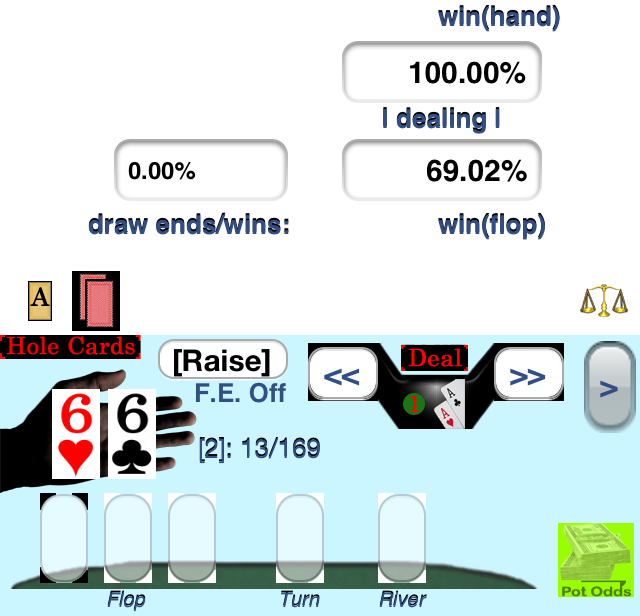
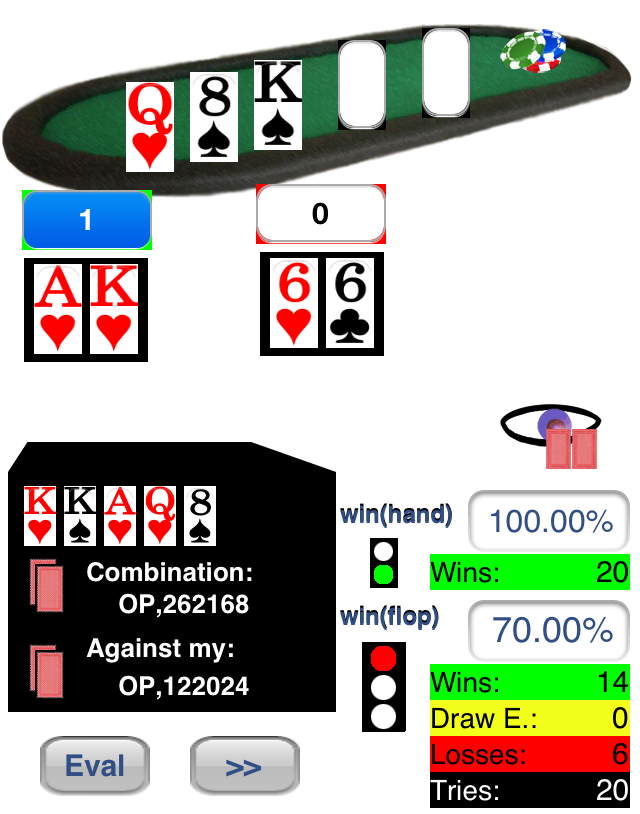
Advice: My 66 against AKs: In the Single Deal Mode you can recognize how to play a pair of sixes the strongest way. Say, you have a strong opponent holding AKs. You don't want to play it on all-in because after the flop you have winning probability of 0.69. Then comes your next protection bet ;). Played on all-in it decreases to 0.52. The Single Deal Mode visualizes that any little pair is much stronger played the right way with target to run against 1 opponent (without a pocket pair) and the according post-flop bet for protection. The initial bet has to be not too much to have an all-in decision neither provoked nor too less running against too many opponents (chaos or three of kind). What some people didn't expect: "Normally One Pair beats AKs!" |
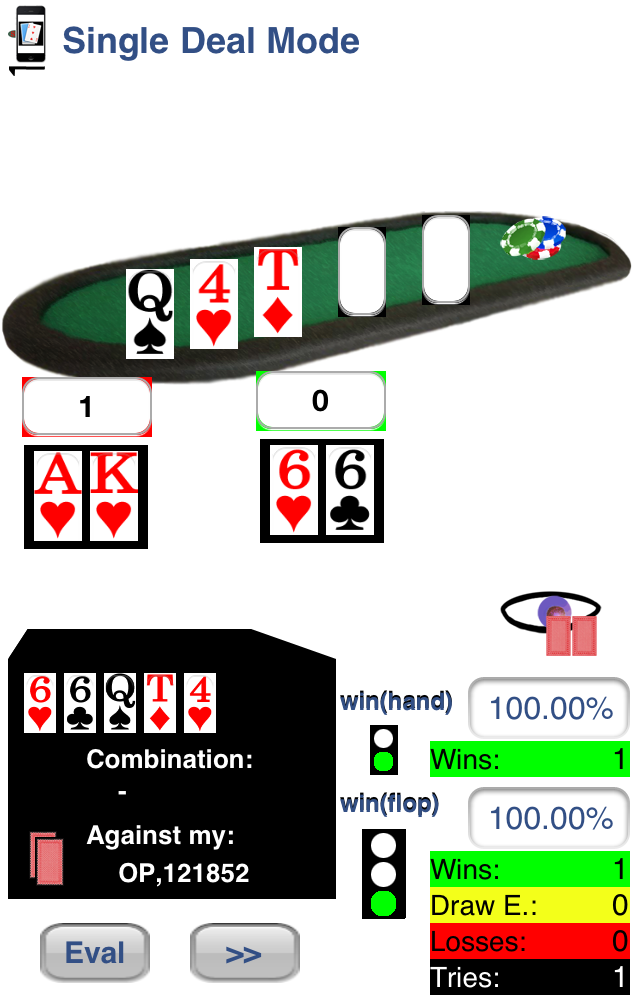
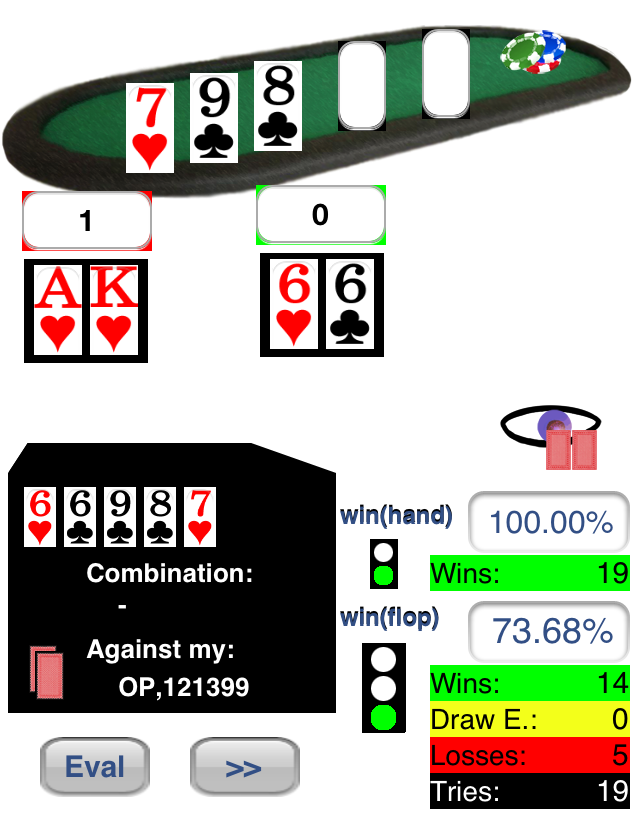
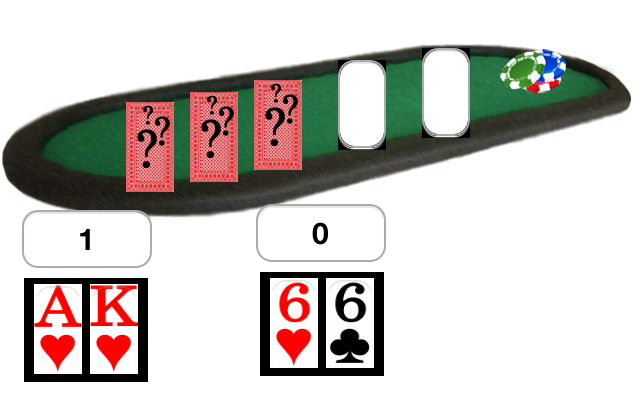 Each tryout can be seen as a single standing empirical experiment. Like taking a card deck and trying things out. The evaluation of a try has its ending. Such an ending can be winning, loosing or a draw. Green is used to visualize wins, yellow the draw endings and red the losses. Using the [Eval] button repeatedly updates the existing statistics with the result of that single attempt. The resulting probabilities of winning are more precise if the [Eval] is used more often. It's recommended to use it at least 5 times to get an overview. |
|
|
|
Using a Random User Hand
In case there aren't any chosen user hole cards or if both cards are explicitly defined as random cards the Single Deal Mode replaces these cards with drawn ones. Thereafter, it asks the user if he's willing to play that dealt starting hand.![[On] Against Best config](images/singleRandomStartConfig.png)
During this visualization always the strongest dealt hand from the table has been chosen (from 9 overall opponents) to run against my own selected hand...
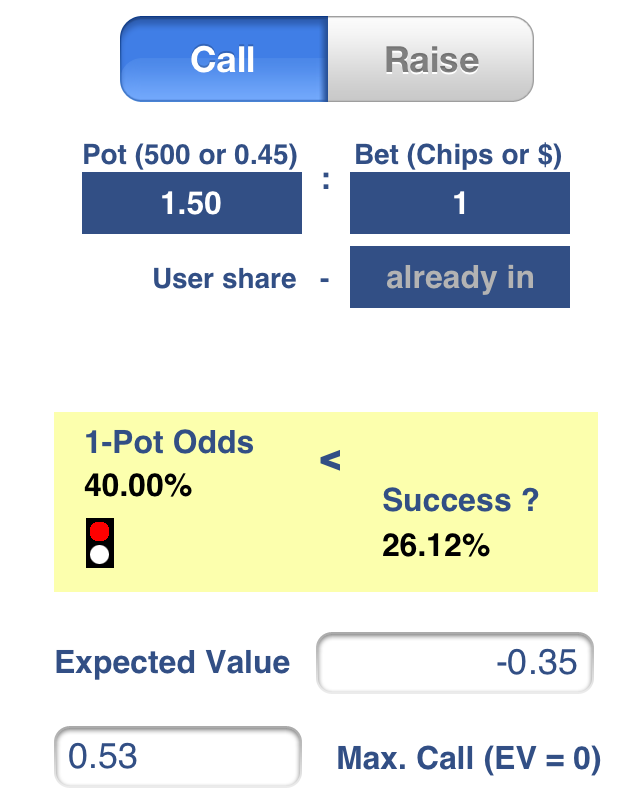
The simulation of playing every dealt hand against the 10-player table's strongest one leads to about a forth as equity of holding the finest hand right after drawing the flop. Beside the first image from that simulation is the image of the decision support screen. On that screen are the pre-defined pot odds. This ratio between Pot and Bet is used to conclude the financial outcomes for playing that specific scenario repeatedly...
![XX vs. [1/9] Simulation with win(flop) = 26.12%](images/singleSimulationXXvsBest.png) When playing every dealt hand this results in a loss of 35 Cents. During this example there's $1.50 in the pot and the call is $1.00. After using a random hand, you might choose to use a break-even-share (e.g. for anyone 1.00$) to make it position independent (no SB or BB). This leads to worse pot odds (1 to 1), what's closer to reality, when playing against an excessive aggressive opponent. |
|
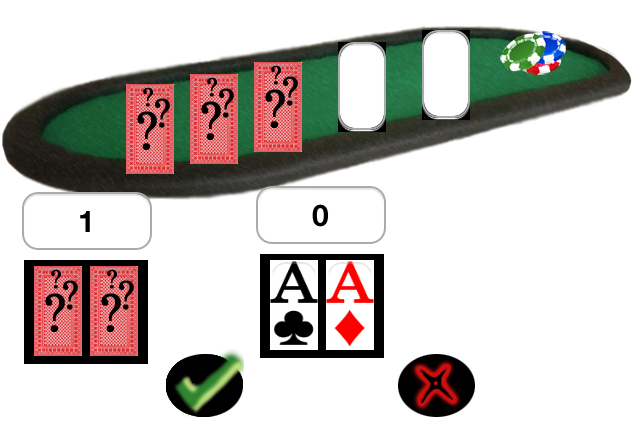 This is the first dealt and used hand: Aces! The opponent holds Ace Jack, the strongest dealt hand out of nine ... 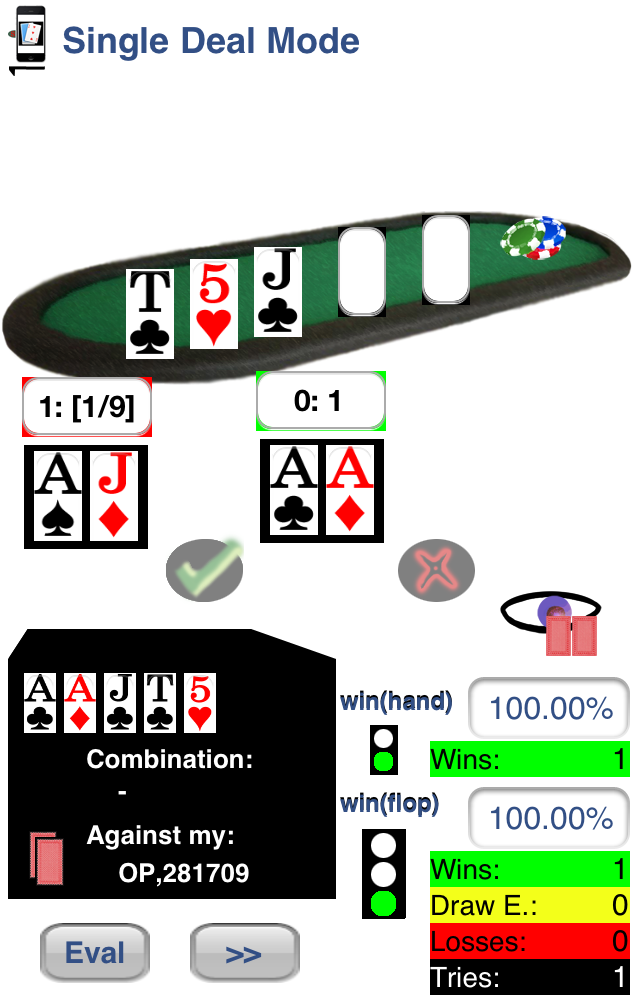
|
The Single Deal Mode supports a Yes/No decision on the dealt starting hand when both user hole cards are randomized. 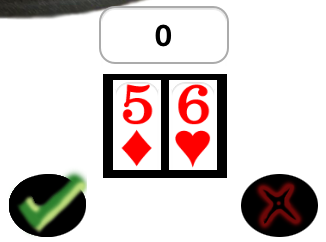 1st Hand: Nope... 1st Hand: Nope...
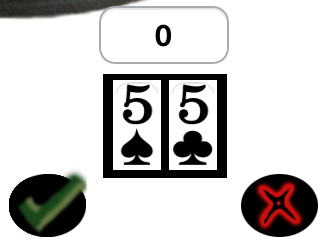 3th Hand: Yepp... 3th Hand: Yepp...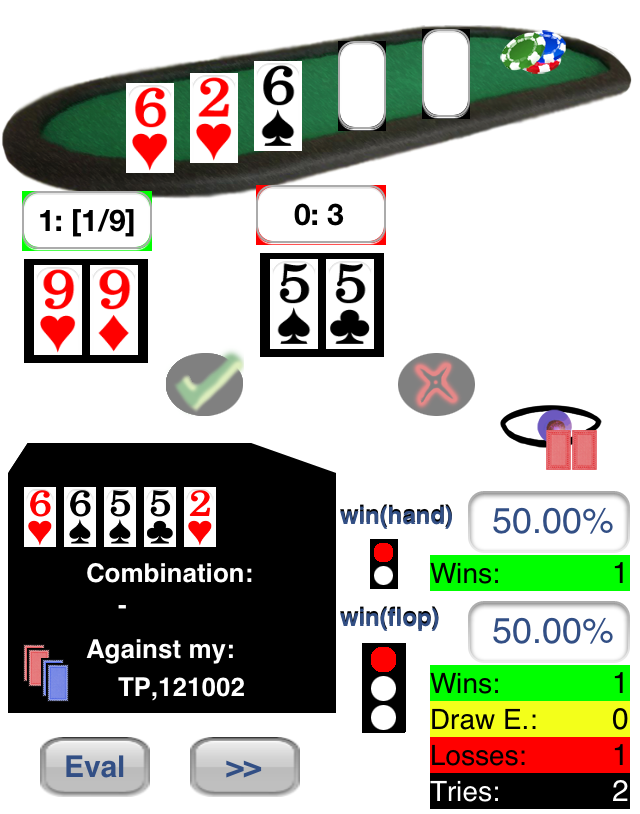
|
Powerful user-based stats: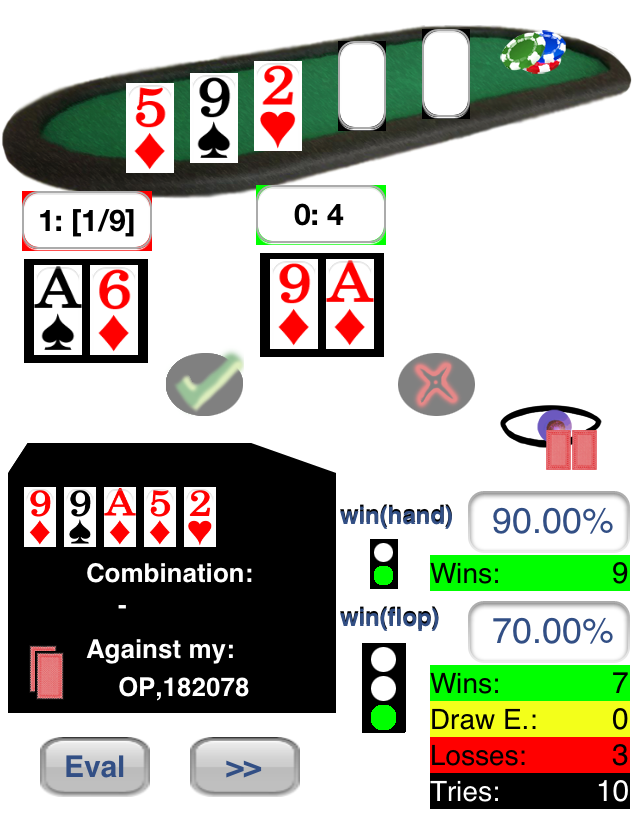 The stats on the right side are based upon 10 played hands out of overall received 116 hands... |
The user's starting hand range...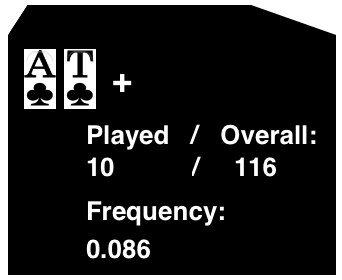 I haven't received more strong hands than expected on this this full ring table, therefore my own playing frequency is 0.086 or under 10%. This leads a starting hand range of ATs+... Interim results of the user's financial outcomes ... after 10 played user hands 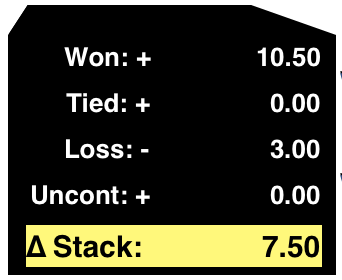
|
|
Final visualization and stat outcomes: ... after 20 played user hands 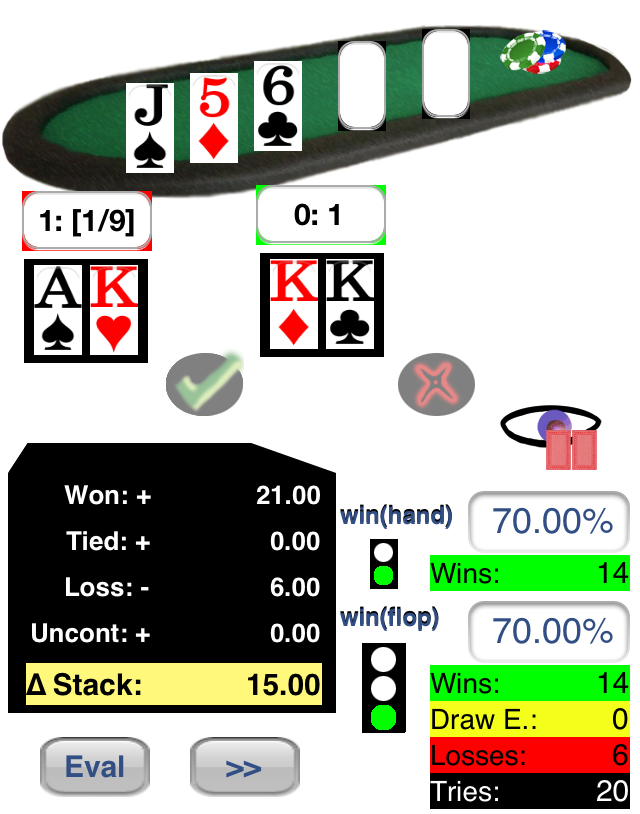 |
During 20 visualizations I have won 14 times. During these games I have lost my wager 6 times. This leads to an overall
stack change of plus $15.00. The user's final starting hand range... 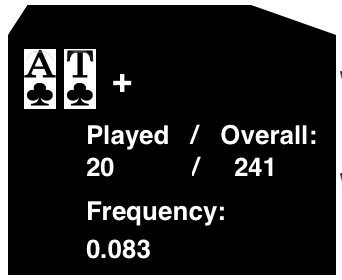 I have been involved a bit more than 8% of all occasions. Therefore I have been calling 20 times out of overall 241 repeated situations. My own starting hand range of ATs+ remains very precisely detected. With other words you need about 10-20 played hand's statistics for resolving the appropriate starting hand range... |
Use cases:
The Single Deal Mode can be used to...- Analyze the effect of any configuration setting
- Find out how to use the app the most efficient way
- Getting an intuitive feeling for applied poker math
- Interpretation of probabilities/odds
- Knowing about the fold equity and it's game implications (when it's useful to steal / which hands need to be protected)
- Understanding pot odds and how they describe your hand's value requirements
- Check your financial progress when playing a situation numerous times
- Analyze known playing frequencies or raising frequencies
- Visualize your hand until its end and learn how to play it stronger (board texture)
- Analyze the performance of a hand with specific communities
- Increase strength in heads up sessions
- Define circumstances to play draws (fold equity, straight and flush draws together, ...)
- Find spots for successfully bluffing


