


 in english
 wechsle die Sprache

|
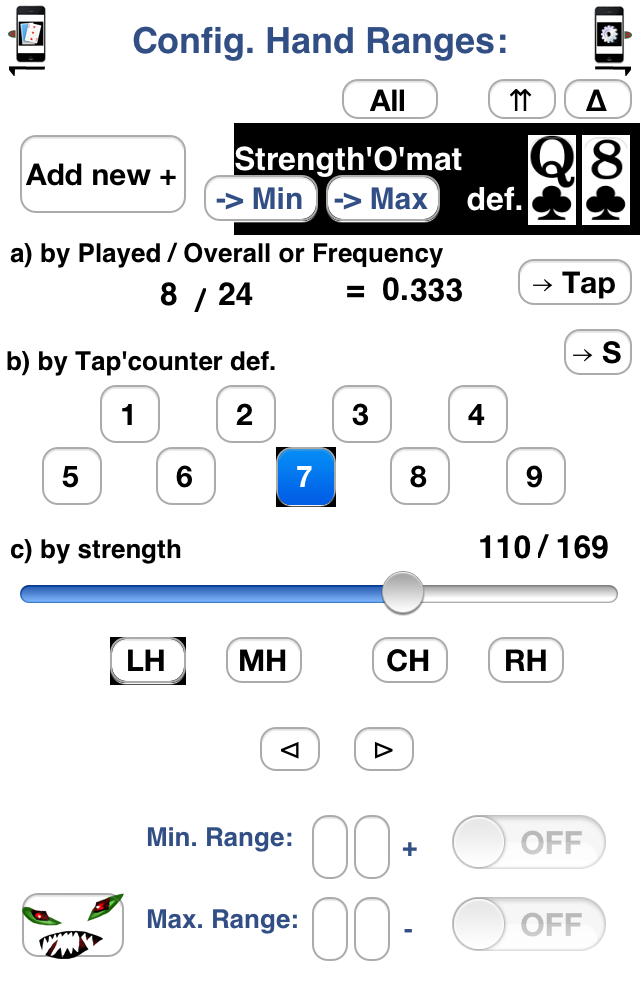
In the starting hand rankings sheet all the 169 generalized starting hands are ordered by their playing strength. This sheet is used to keep the overview over the following hand range for the opponent. This used starting hand range includes all the hands which are following above the selction; these hands are considered being stronger at the 10-player table withou a Pre-Flop All-In declaration (equal/better ranked than 60/169). Furthermore the barrier hand of the range is always included within the range (e.g. Q8s). |
| At the 10-player table all hands better/equal than Q8s come up with a occurrence rate or frequency of one third or 0.33. In iRuleThem this leads to the starting hand range Q8s+. It's a range (array of hands) and not a single hand, so its average strength is exactly in between Q8s and AA. This leads to the calculation 1 divided by 6 what makes 0.167. This is the hand KQ as average hand strength for this opponent's range. |
|

|
Versus: 
|

|
1. When someone with the hand KQ from the cut-off position decides to limp (only spend 1 Big Blind bet), and
an opponent with the range Q8s+ previously has only called 1 Big Blind, then at least the player in the Big Blind position
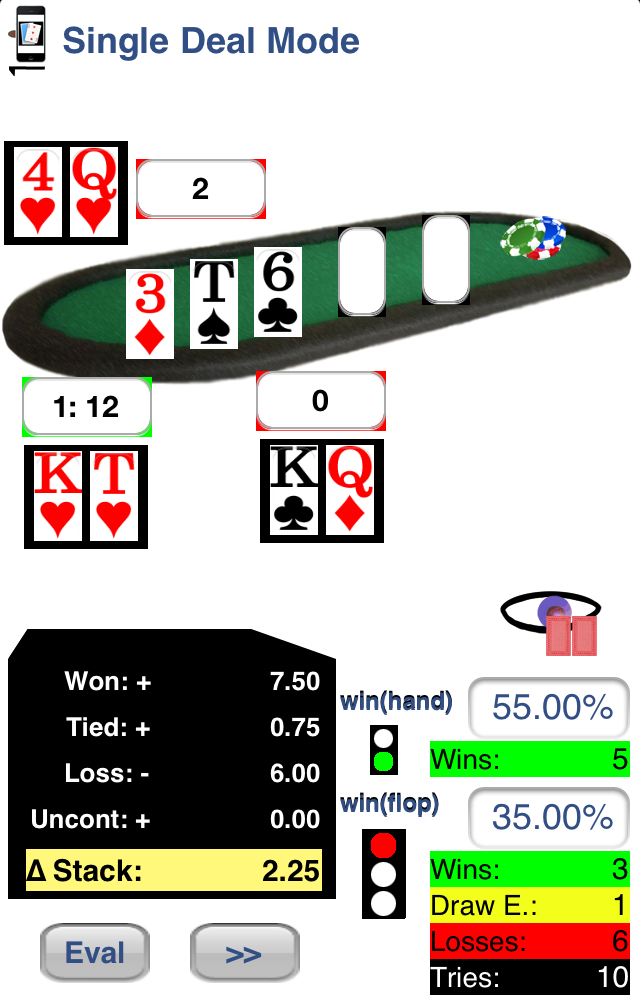
remains involved too. Therefore random cards are used for the Big Blind position. iRuleThem reveals that this makes an equity of 35% after drawing the yet unknown Flop. With other words, in about a third of all tries he holds the strongest hand. After simulating the first scenario with iRuleThem and checking the Pot Odds he recognizes that this is a profitable call... Overall there're $2.50 in the pot and $1.00 is requested. The Expected Value is $0.23; therefore by betting 1 Doller he receives an average profit of 23 Cents right after drawing the Flop (+EV). |
| After using the Single Deal Mode for 10 hand visualization examples, overall he would have earned a plus of $2.25 by repeatedly playing this situation through. 3 times he has won, 6 times he has lost and for once there has been a draw ending. |
|
2. Furthermore, when it's likely that all remaining opponents (including these on the dealer-button and the blind positions) give up their hands
after facing his pre-flop raise, it's even more valuable when raising KQ to 3 times the Big Blind. The chance of winning an uncontested pot
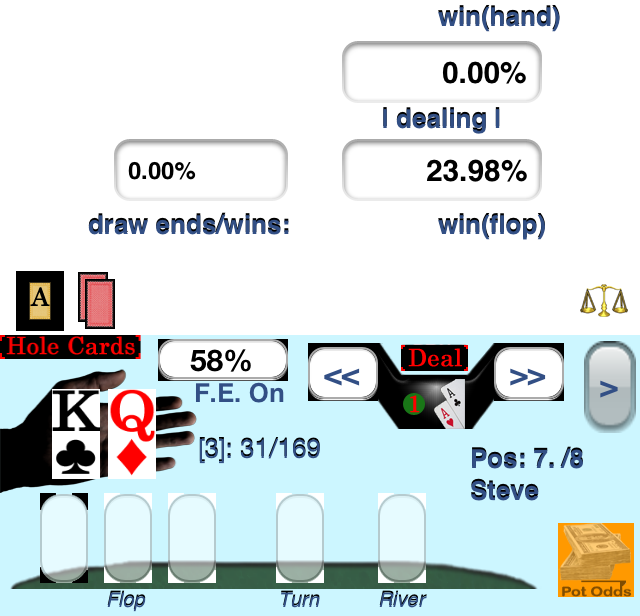
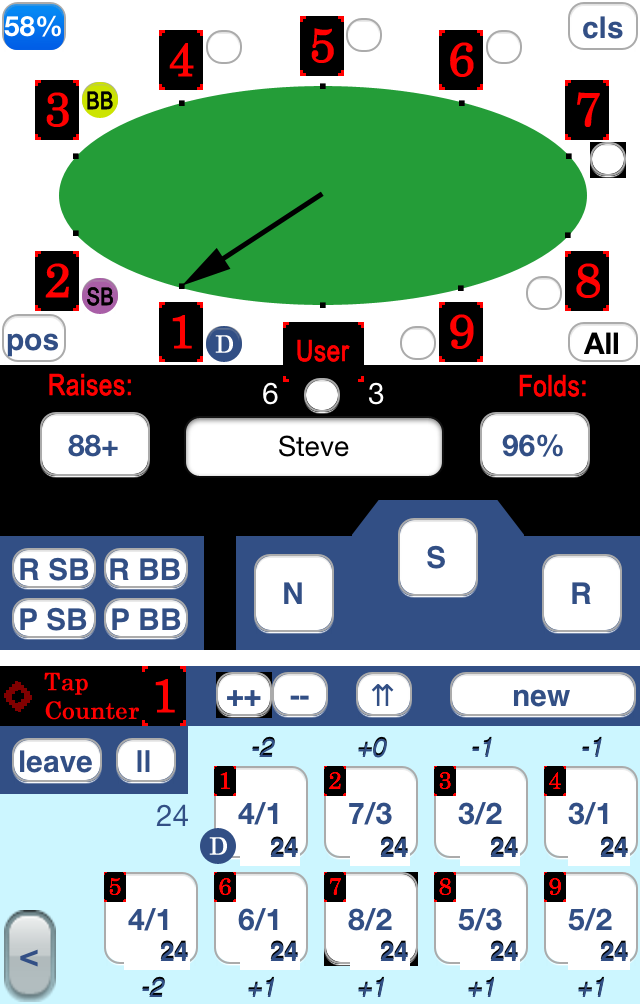
is known as Fold Equity (F.E.). For this specific example the Tap'Counter has concluded the overall pre-flop fold equity of 58%.
|
|
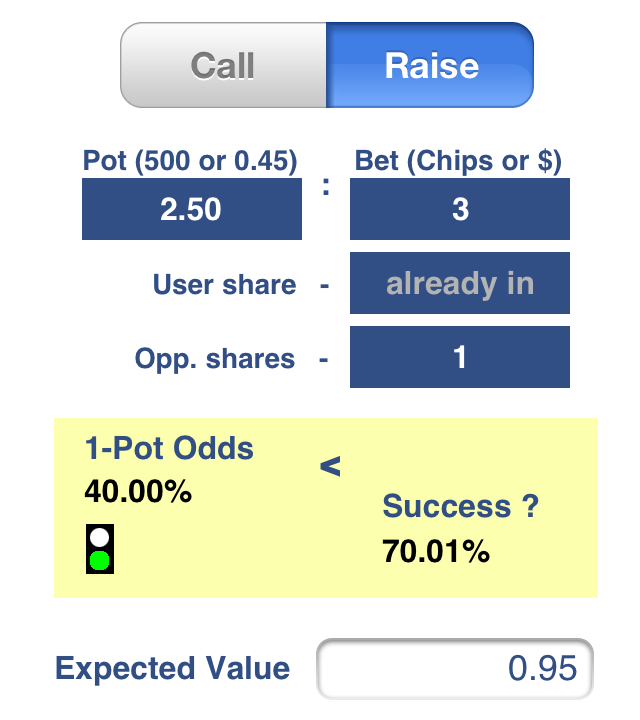
Versus 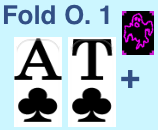 This ghost range is automatically calculated from the Tap'Counter by analyzing the available data. Therefore the given computed Fold Equity (58%) is touched. Anyone of these 4 remaining opponents could finally make the call. Each one of them would be folding their weaker holdings and only continue with a hand equal/stronger than ATs. The expert's overall success expectation (including the overall fold equity of 58%) reaches 70%. This move from this specific position is therefore significantly stronger played. Generally seen on average he would be called by stronger hands but would receive enough fold equity to make this play multiple times more profitable. This fact can be seen by considering the Expected Value (EV) -- it's value after raising the bet is 95 Cents (higher +EV). |
|

|
During the second scenario by betting $3.00, he wins the pot a bit more than half the attempts uncontested. On the other half
he receives a winning expectation of only 24%. It's important to be aware that the opponent's hand range for
calling such a raise is now changed to ATs+. Another Single Deal Mode evaluation of 10 games (only 4 hand visualizations - 6 times were uncontested) leads to a stack change of $+9.31. 1 time he has won, 3 times he has lost and 6 times he would have won the pot uncontested. This 10 games financial stack outcome can be directly compared to the calling example above. Therefore the pro is aware that raising is the more profitable decision here, all thanks to the iRuleThem App - which is fully evidence-approved. |


